LED screens have become practical tools for retail stores, stadiums, offices, transport hubs, and outdoor advertising. In 2026, popular options include indoor fine-pitch displays, outdoor direct-view LED screens, rental panels, transparent LED screens, and emerging microLED systems. Each type serves a different environment. Pixel pitch, brightness, viewing distance, and weather protection all affect performance.
Many buyers ask, “what is the lifespan of an LED screen?” The answer is rarely one fixed number. Quality commercial displays often reach 80,000 to 100,000 hours before brightness falls to about 70% of its original level. Some budget products may show visible decline much sooner. Lifespan does not mean the screen suddenly stops working. It usually describes gradual brightness loss, color changes, and increasing maintenance needs.
Usage conditions matter greatly. A stadium screen facing intense sunlight and heat works harder than an indoor lobby display. Poor ventilation can accelerate component aging. Constant operation also increases thermal stress. Reliable installation, stable power, dust control, and scheduled inspections can extend usable service.
A neat number can mislead. Real installations are messier. LED modules may fail individually, while the remaining screen continues operating. Technicians can often replace modules, power supplies, or receiving cards without removing the entire wall. Manufacturer specifications provide a starting point, but service records reveal more. This guide compares the leading LED screen types for 2026 and examines lifespan through practical conditions, not marketing claims alone. Some estimates remain uncertain, especially for newer technologies with limited long-term field data.
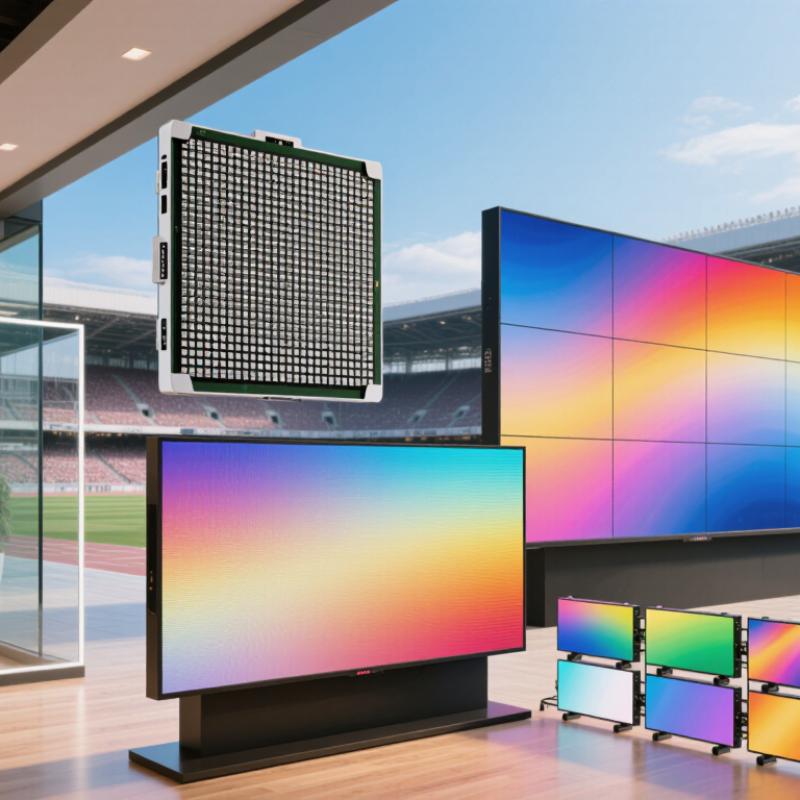
In 2026, LED screens mainly fall into indoor fine-pitch, outdoor, rental, transparent, flexible, COB, and microLED categories. Each type solves a different viewing problem. Indoor fine-pitch screens use smaller pixels for meeting rooms, control centers, retail displays, and studio backgrounds. Their close viewing distance demands careful calibration and stable brightness.
Outdoor LED screens use weather-resistant cabinets, higher brightness, and stronger protection against dust and moisture. They suit stadiums, roadside advertising, public squares, and building façades. Rental screens are lighter and designed for repeated assembly. Their quick-lock structures help touring events, although frequent handling can increase connector and cabinet wear. Transparent screens preserve window visibility, while flexible screens fit curved columns and unusual surfaces.
COB technology can offer stronger surface protection and fine pixel spacing. MicroLED may deliver excellent contrast and long operational potential, but installation cost and supply complexity still limit many projects. The categories overlap. A transparent screen can also be outdoor-rated, and a rental screen can serve indoor or outdoor events. That classification is not perfect.
Lifespan often reaches 80,000 to 100,000 hours under controlled conditions, but this figure is not a guarantee. High brightness, heat, humidity, dust, and poor power quality can shorten service life. In practice, maintenance records matter as much as specifications. Check module replacement access, ventilation, calibration support, and protection ratings before selecting a screen. A lower-brightness display may last longer than a constantly overdriven one. That trade-off deserves honest review.
| LED Screen Type | Typical Applications | Typical Pixel Pitch | Typical Brightness | Expected Lifespan* | Recommended Environment | Key Characteristics |
|---|---|---|---|---|---|---|
| Indoor Fine-Pitch LED | Control rooms, meeting rooms, broadcast studios, museums and premium retail | Approximately 0.7–2.5 mm | 600–1,500 nits | 80,000–100,000 hours | Indoor, controlled temperature and humidity | High pixel density, close-viewing performance and low viewing-distance requirements |
| Indoor Standard-Pitch LED | Shopping centers, event halls, churches, campuses and indoor advertising | Approximately 1.8–4.0 mm | 800–1,500 nits | 80,000–100,000 hours | Indoor locations with limited direct sunlight | Balanced image quality, viewing distance and installation cost |
| Outdoor Fixed LED | Building façades, roadside advertising, stadiums, transport hubs and public spaces | Approximately 3–16 mm | 4,000–10,000 nits | 80,000–100,000 hours | Outdoor use; weather protection and thermal management required | High brightness, weather-resistant cabinets and wide viewing angles |
| Rental and Touring LED | Concerts, exhibitions, conferences, festivals and temporary installations | Approximately 2.6–6.9 mm | 3,000–5,000 nits | 60,000–100,000 hours | Indoor or outdoor, depending on enclosure rating | Lightweight modular cabinets, fast setup and repeated transport capability |
| Transparent LED | Glass façades, shop windows, airports, architectural features and stage backdrops | Approximately 3.9–10 mm | 3,000–7,000 nits | 50,000–100,000 hours | Indoor or outdoor, subject to design and weather protection | Allows daylight and sightlines to pass through; lower visual obstruction |
| Flexible LED | Curved columns, creative installations, stage design and interior architecture | Approximately 1.5–4.0 mm | 800–4,500 nits | 50,000–80,000 hours | Mostly indoor; outdoor use requires purpose-built protection | Bendable modules support concave, convex and irregular display surfaces |
| COB / Mini LED Display | Premium indoor signage, command centers, corporate spaces and high-resolution visualization | Approximately 0.7–1.8 mm | 600–1,500 nits | 80,000–100,000 hours | Indoor, clean and temperature-controlled environments | Higher pixel protection and fine-pitch capability; surface repair requirements vary by design |
An LED screen converts electrical signals into light through thousands of tiny diodes. Each pixel usually combines red, green, and blue sub-pixels. Current control adjusts their brightness. Pulse-width modulation makes changes quickly, but efficiency is not perfect.
Common designs include SMD, COB, MiniLED, and MicroLED. They differ in chip placement, pixel size, surface structure, and manufacturing difficulty. Each design suits different viewing and installation needs. There is no universal winner.
SMD screens place separate LED packages onto a circuit board. They provide strong brightness and flexible pixel pitches. Technicians can usually service their modules more easily. A damaged section may be replaced without rebuilding the entire screen.
COB screens mount multiple LED chips directly onto a substrate. This creates a smoother surface with stronger impact resistance. The surface may feel more continuous and less exposed. Repairs can be more demanding, however.
MiniLED uses much smaller diodes for backlighting. MicroLED uses microscopic pixels that emit light independently. These designs can improve contrast and screen uniformity. Their production requires extremely accurate manufacturing. MicroLED remains difficult to produce consistently.
It usually refers to the light source reaching L70. L70 means output falls to 70% of its initial level. Fifty thousand hours equals about 5.7 years of continuous operation. At ten hours daily, it equals roughly 13.7 years. I would not treat it as a promise.
Heat is often the most serious factor. High cabinet temperatures can weaken diodes, power supplies, solder joints, and driver circuits. Humidity, dust, ultraviolet exposure, and temperature changes also create stress. Maximum brightness produces more heat. Poor ventilation quietly causes damage.
Keep brightness near the level the viewing area requires. Avoid maximum output unless conditions genuinely demand it. Record cabinet temperatures during hot afternoons. Clean filters and ventilation paths regularly. Use stable power and suitable surge protection. Small maintenance tasks matter.
Watch for dead pixels, color shifts, flicker, and uneven brightness. A screen may still operate while appearing visibly inconsistent. Power supplies or modules often need replacement before the diodes fail. Maintenance records are often incomplete. That makes lifespan estimates less certain.
A well-maintained screen may remain usable for eight to twelve years. Harsh outdoor conditions can reduce that period considerably. Actual service life depends on temperature, humidity, brightness, and operating hours. The rated number alone is insufficient. Real installations are messier.
In 2026, LED screens are available in several forms, including indoor fine-pitch displays, outdoor high-brightness screens, rental panels, transparent screens, flexible displays, and all-in-one LED solutions. These technologies create images through tiny light-emitting diodes, while pixel pitch, diode structure, brightness control, and protective design determine their performance in different environments. Understanding how each type works helps users select a screen for advertising, events, control rooms, retail spaces, or large public installations.
When asking “what is the lifespan of an LED screen,” the answer depends on usage, operating hours, brightness settings, heat management, humidity, installation quality, and maintenance. Many professional LED screens can operate for around 80,000 to 100,000 hours before reaching reduced brightness, although actual service life may vary by model and conditions. Regular cleaning, proper ventilation, stable power, suitable brightness, timely replacement of damaged modules, and professional inspections can significantly extend performance and reduce long-term maintenance costs.

 LYRA LED